
A Simple Routine for Students Who Struggle With Letter Recognition
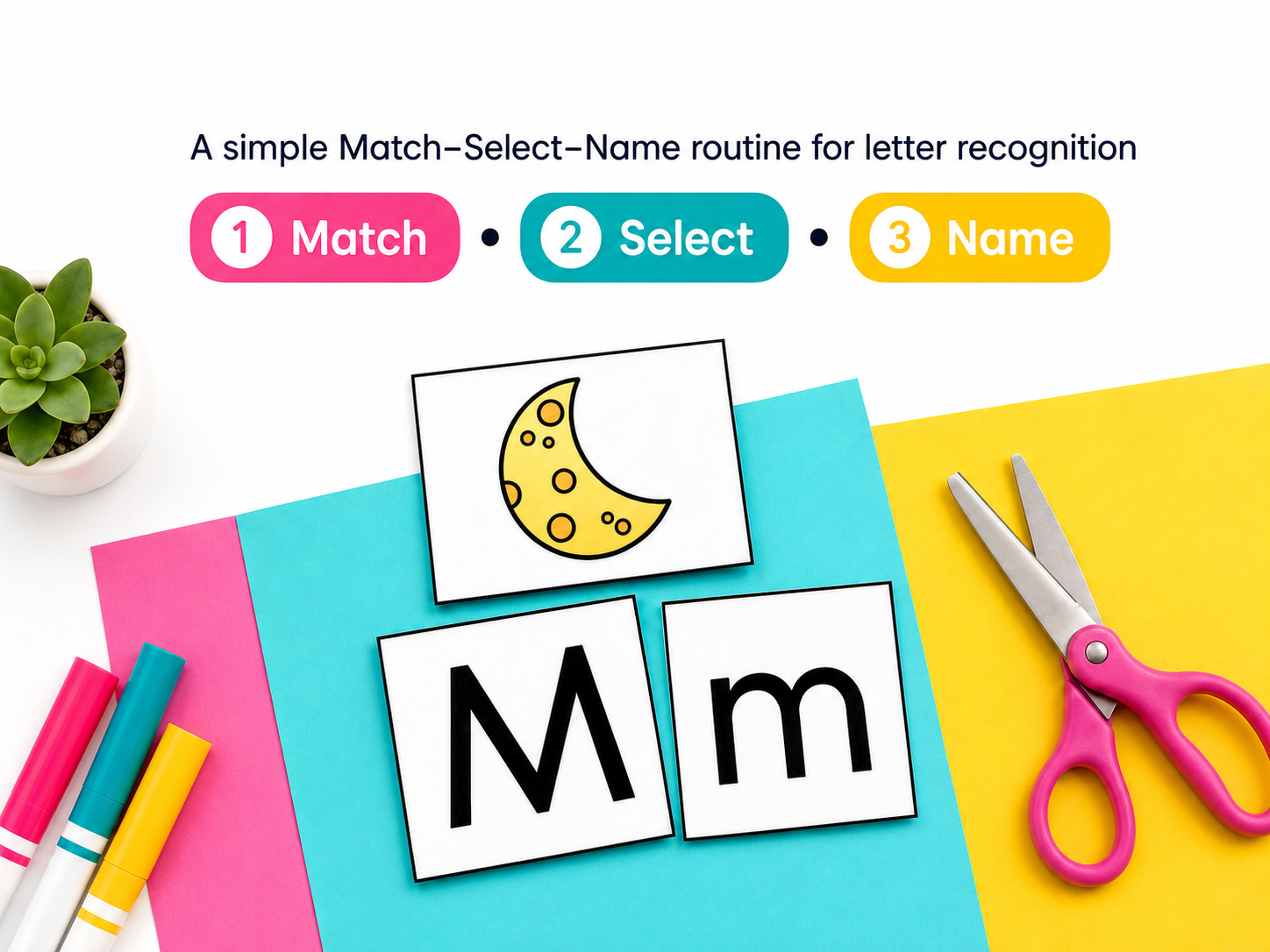
Some students learn letter names quickly.
Others need much more repetition, more structure, and a more concrete way to practice before letter recognition becomes automatic.
For students who seem to be “stuck” on letter names, I like a simple routine called Match–Select–Name.
Instead of asking a student to immediately identify a letter independently, the routine breaks the task into smaller steps:
Match → Select → Name
That progression can give students repeated success while gradually increasing the level of difficulty.
How Does Match–Select–Name Work?
The routine is simple:
MATCH: The student matches one letter to another identical letter.
SELECT: The student points to or chooses the correct letter from a small group.
NAME: The student names the letter independently.
The important part is the sequence.
A student who cannot yet say, “That is M,” may still be able to match M to M. Once that skill is secure, the student can move to selecting M when asked. Naming the letter comes last.
For some learners, that gradual progression can make letter learning feel much more manageable.
Why Start With Matching?
Naming a letter requires a student to look at a visual symbol, recognize it, retrieve the correct label from memory, and say the name.
That can be a lot for a beginning learner.
Matching removes some of that demand.
The student is simply answering:
Which one looks the same?
Once the visual form of the letter becomes familiar, the teacher can move to selection:
Show me M.
Only after the student can consistently recognize the letter does the routine require independent naming:
What letter is this?
It is a small change in instruction, but for students who need more repetition, those smaller steps can be very helpful.
Use Picture Cues When They Help
Some students benefit from having a consistent picture connected to each letter.
For example, a student working on M m might use a picture of a moon.
The picture is not meant to become a permanent guessing strategy. It is simply an additional cue while the student is learning the letter.
As recognition improves, the picture cue can be faded and the student can work directly with uppercase and lowercase letters.
Not every student needs picture support, so the routine can be adjusted accordingly.
Practice Uppercase and Lowercase Letters Together
Students need to recognize that M and m represent the same letter even though they look different.
Once a student can match identical letters, instruction can gradually include:
uppercase to uppercase
lowercase to lowercase
uppercase to lowercase
lowercase to uppercase
the same letter in different fonts and sizes
This helps students move beyond recognizing one very specific version of a letter.
Add Repetition Without Making Practice Feel Repetitive
Students who struggle with letter recognition often need many more opportunities to practice than their classmates.
That does not mean they have to complete the same activity over and over.
The same target letters can be practiced through a variety of activities:
matching cards
picture and letter matching
letter lotto
cut-and-paste activities
letter hunts
flashcards
desk strips
handwriting practice
memory games
simple movement games
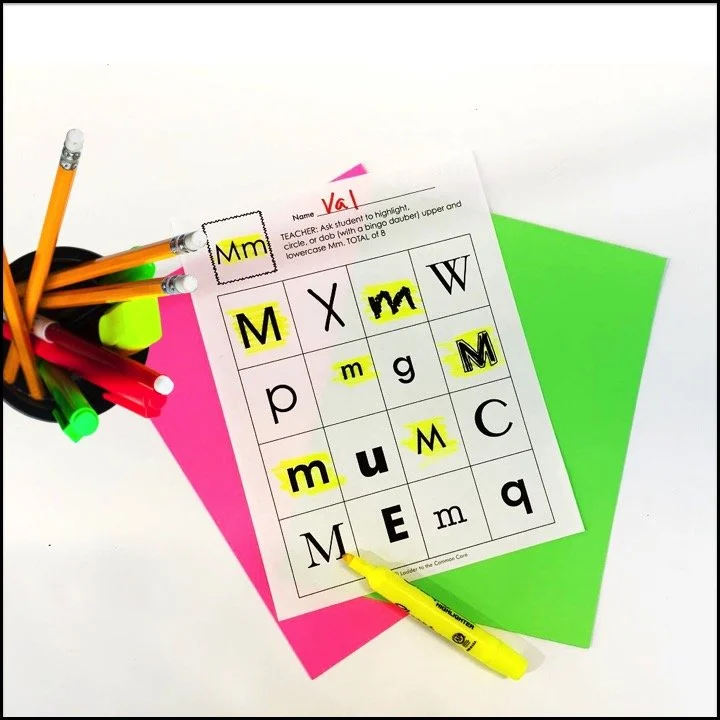
Sample Letter Find
The goal stays the same while the activity changes.
That variety can help students get the repetition they need without making practice feel tedious.
Include Letter Formation
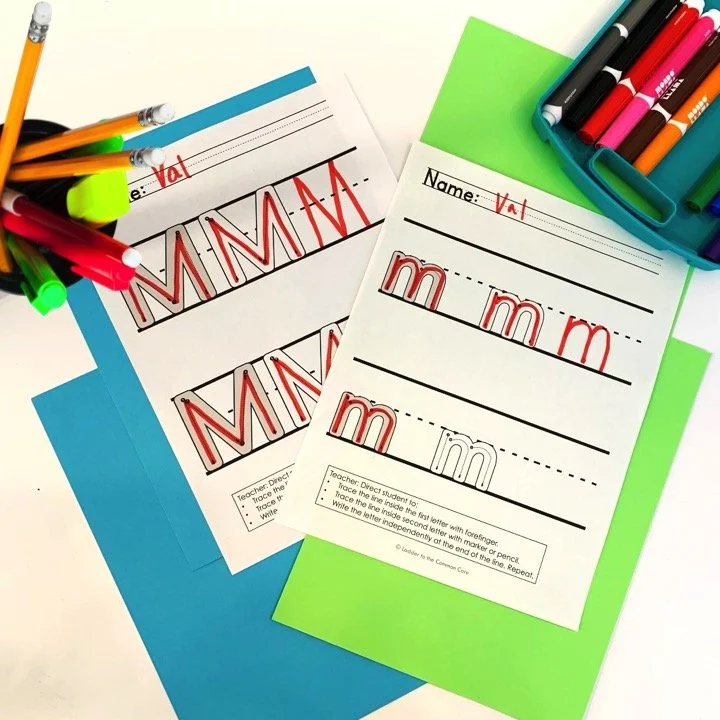
Sample Letter Formation
Letter recognition and handwriting support one another.
Once a student is learning to recognize a letter, it is useful to also practice forming it.
Some students may begin by tracing the letter before moving to independent writing.
For example:
M M M
and
m m m
Tracing, copying, and eventually writing the letter independently can provide another way for students to become familiar with its shape.
Keep the Routine Short and Consistent
A letter intervention routine does not have to take a long time.
In fact, short and frequent practice is often easier for students to tolerate than a long drill session.
You might work on just a few letters at a time and repeat the same basic routine each day:
Match it.
Select it.
Name it.
Write it.
As the student becomes successful, add another letter or reduce the amount of support.
Watch for Real Progress
It is easy to assume a student “knows” a letter after seeing one successful response.
But students who struggle with letter recognition often need to demonstrate the skill across different materials and situations.
Can the student recognize the letter:
on a flashcard?
on a worksheet?
in a different font?
among several other letters?
in uppercase and lowercase?
without the picture cue?
Those small changes can reveal whether the student has truly learned the letter or is still relying on a particular visual prompt.
Keeping a simple data sheet can also help identify which letters are secure and which still need practice.
What If a Student Is Still Struggling?
If a student continues to have difficulty, slow the routine down.
Use fewer letters.
Increase repetition.
Return to matching.
Add a picture cue.
Use larger cards.
Reduce the number of choices.
Give the student more opportunities to respond correctly before increasing the difficulty.
The goal is not to rush through the alphabet.
The goal is for the student to build reliable, automatic letter recognition.
The Bottom Line
Some students simply need a more gradual pathway to letter identification.
Match–Select–Name breaks the task into manageable steps:
Match the letter.
Select the letter.
Name the letter.
From there, students can practice those same letters through games, worksheets, handwriting, and other activities until recognition becomes more automatic.
For students who have struggled with traditional letter drills, a simple, predictable routine can provide the repetition and success they need to keep moving forward.
Looking for a Ready-to-Use Letter Intervention?
My Match–Select–Name Letter Intervention resource includes a step-by-step teacher routine along with picture cards, uppercase and lowercase letter cards, cut-and-paste activities, lotto games, desk strips, letter-find practice, handwriting sheets, data pages, and additional games.
It is designed to make it easy to provide repeated letter-recognition practice while gradually moving students from matching to independent naming.
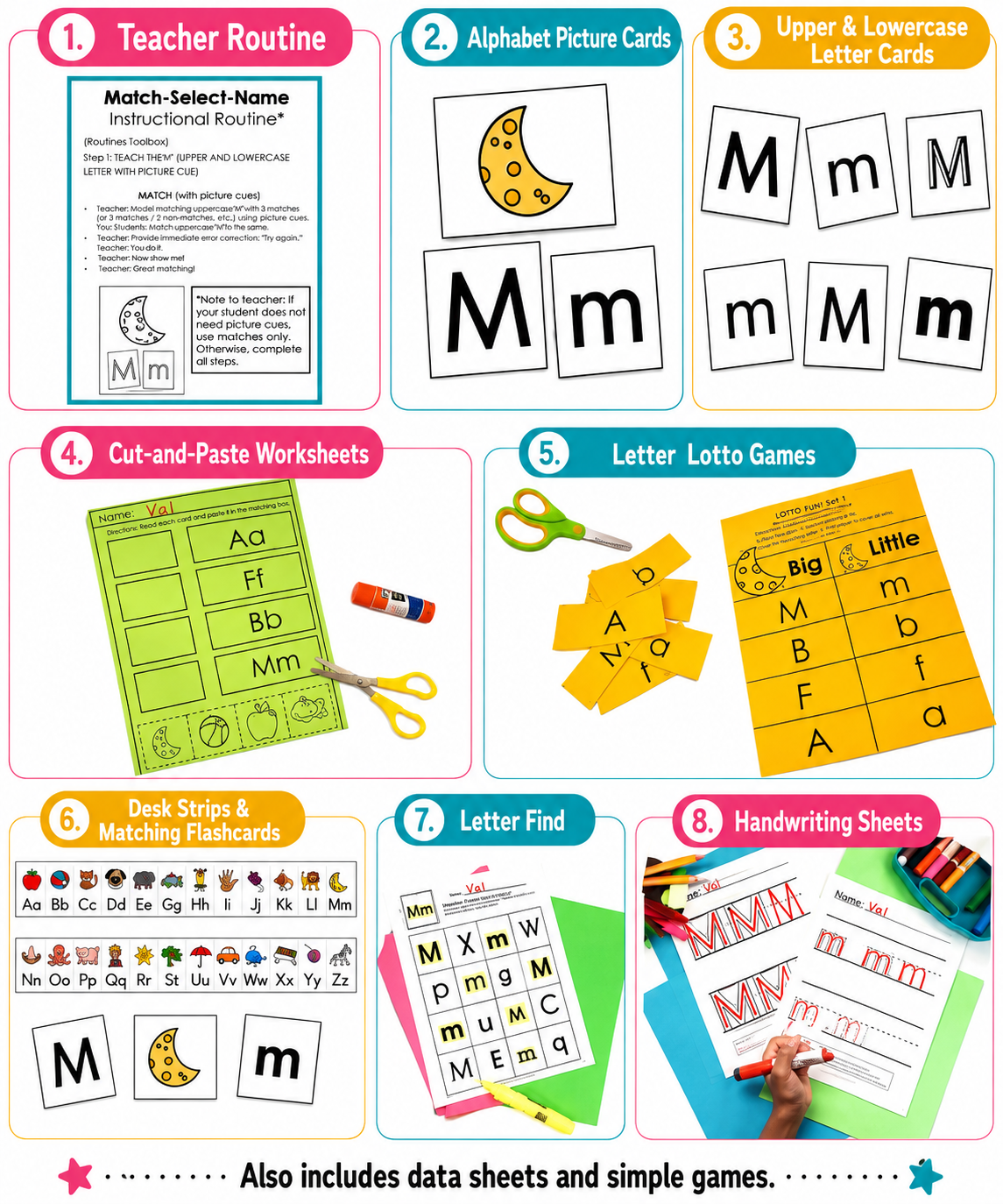
What Does it Include?
Alphabet Picture Cards: 26 cards include a keyword picture for each letter of the alphabet. Choice of color or B & W. (Print on cardstock, laminate if desired.)
(Small Set) Upper and Lowercase Letters for matching to Alphabet Picture Cards above. (Print on cardstock, cut, laminate if desired.)
(Large Set) Upper and Lowercase Letters: For match-select-name without picture cues. (Print on cardstock, laminate if desired.)
Big Block Cut and Paste Worksheets for matching keyword pictures/letters. Only four letters/pictures to a page for easy cutting and pasting. Perfect for independent work or homework.
Letter Lotto Games: To practice matching upper and lower case letters. (Print on cardstock, cut, laminate if desired.)
Alphabet Desk Strips: To teach the sequence of letters and review of letter names. Choice of color or B & W. (Print on cardstock, cut into strips on dotted lines, tape and laminate to make two strips: A-M and N-Z.)
Matching Alphabet Flashcards : Use with desk strip above. (Print on cardstock, cut into individual cards and laminate if desired.)
Letter Find: Identify upper and lower case letters in different fonts and sizes.
Handwriting Sheets: 2 types of handwriting pages are provided for each letter. For students who need more support, the first worksheet requires only tracing. The second sheet provides for tracing as well as independent letter formation.
Data Sheets: Match-Select-Name and Letter Formation For progress monitoring.
Games: Memory, Flashlight Fun, Beanbag Toss.