
Building Number Sense: 6 Essential Skills and How to Teach Them
Strong number sense helps children understand how numbers work—not just how to count or complete a calculation.
Many young children begin developing number sense through everyday experiences. They learn that two cookies are fewer than five cookies, that the number after 7 is 8, and that a group of objects can be counted to find out how many there are.
But these ideas do not develop automatically for every learner. Some students, especially those who need more explicit instruction, benefit from direct teaching, repetition, visual supports, and hands-on practice.
So what exactly is number sense?
Number sense includes a child’s ability to understand quantities, recognize relationships between numbers, and use numbers flexibly. Here are six important skills that help build that foundation.
1. Count with One-to-One Correspondence and Understand Quantity
Children often learn to recite numbers before they fully understand what counting means. A child may be able to say:
1, 2, 3, 4, 5... but still need practice counting objects accurately. When counting a group, students need to understand two important ideas:
Each object is counted once and only once.
The last number said tells how many objects are in the group.
For example, when a child counts five cookies, the word five represents the total quantity.
How to Help
Count the Room.
Have students count real objects in the classroom while touching or pointing to each one. Count windows, chairs, books, bins, desks, or bulletin boards.
Count Actions.
Call out a number and an action:
Clap 4 times.
Stomp 8 times.
Touch your toes 6 times.
This helps students connect number words with actual quantities.
Count Objects.
Label small containers with numbers. Give students manipulatives such as counting bears, buttons, counters, erasers, or pom-poms and ask them to place the correct quantity in each container.
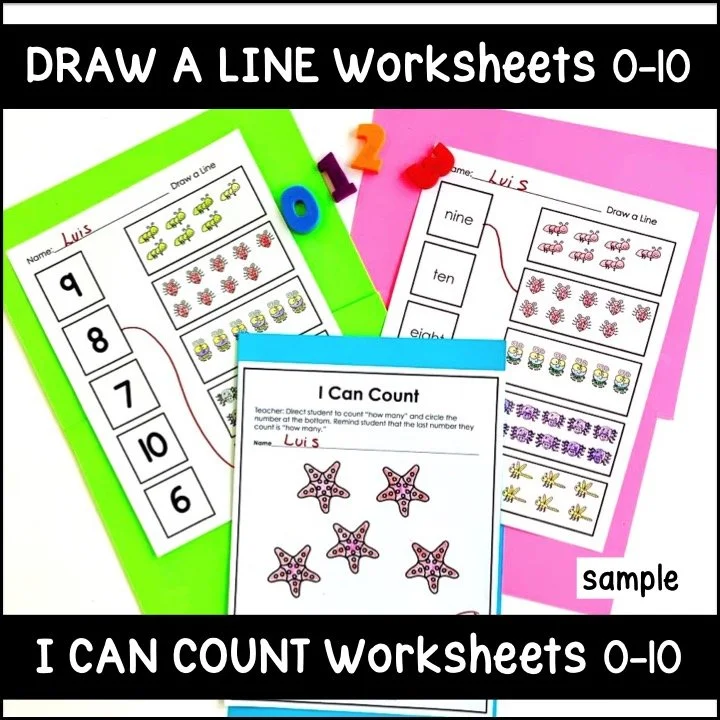
Example Activity from my Number Sense Bundle
2. Understand Number Sequence
Students need to understand that numbers follow a predictable sequence. Seven comes before eight. Nine comes after eight. These relationships stay the same.
Understanding number order helps prepare students for counting on, comparing numbers, addition, subtraction, and many other math skills.
How to Help
100 Chart Activities.
Cut a 100 chart into strips such as 1–10, 11–20, 21–30, and so on. Mix the strips up and have students place them in order.
Number Cups.
Write the numbers 1–10 on paper or plastic cups. Have students put the cups in order. Then ask questions such as:
What number comes before 5?
What number comes after 7?
Which number is between 3 and 5?
Seasonal paper cups can make this an easy center activity.
Play Number-Based Board Games.
Games such as Chutes and Ladders give students repeated exposure to number order while they play.
3. Connect Numerals to Quantities
Recognizing the numeral 6 is different from understanding what six actually means.
Students need many opportunities to connect written numerals with real quantities.
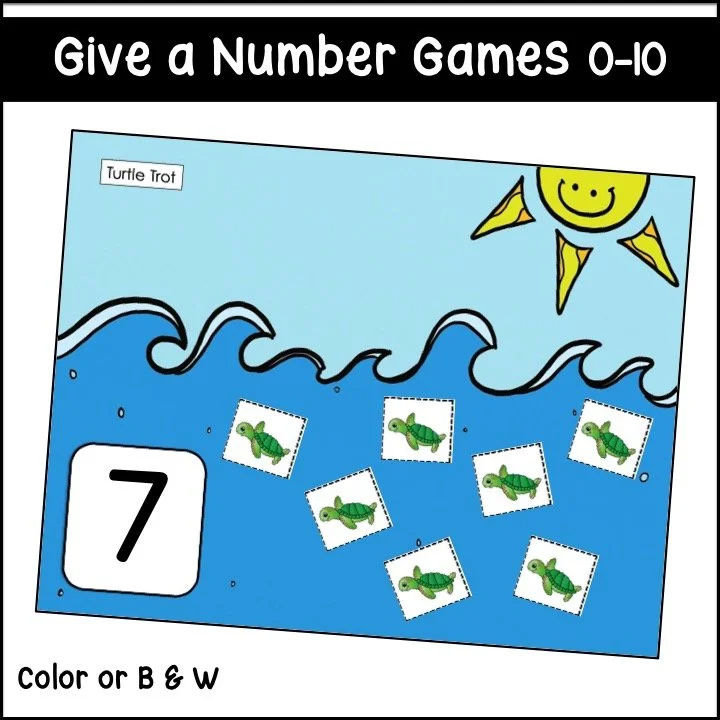
Example Activity from my Number Sense Bundle
How to Help
Number the Room.
Give students sticky notes and have them label collections around the classroom. If a bin contains six books, for example, the student might write:
6 — six and place the sticky note on the bin.
Ten-Frame Practice.
Give each student a ten frame and a set of small objects. Students choose a number card from 0–10 and place that many objects on the frame.
Ten frames are especially helpful because they allow children to begin recognizing quantities without counting every object individually.
4. Compare Numbers and Quantities
Number sense also includes understanding relationships such as:
more
less
same
Students should gradually learn to compare quantities both visually and numerically.
How to Help
Counting Beans.
Fill a large bowl with dried beans and provide two smaller bowls.
Have the student scoop a handful of beans into each bowl. Then ask:
Which bowl has more?
Which has less?
Label the bowls with sticky notes marked MORE and LESS.
For an additional challenge, ask the student to add or remove beans until both bowls have the same amount.
5. Compose and Decompose Numbers
Students with strong number sense begin to understand that numbers can be made in different ways.
For example:
5 can be:
2 + 3
4 + 1
5 + 0
This understanding of parts and wholes becomes increasingly important as students move into addition, subtraction, multiplication, and division.
How to Help
Provide students with tools that make number relationships visible.
Useful materials include:
ten frames
counters
part-part-whole mats
number lines
small whiteboards
connecting cubes
fingers
drawings
Encourage students to explain how they solved a problem.
The goal is not simply to get the correct answer, but to help students see that numbers can be broken apart and put back together in flexible ways.
6. Estimate Reasonably
Number sense also includes being able to make a reasonable estimate.
A child does not need to count every crayon in a box to recognize that there are probably closer to 10 crayons than 100.
Estimation helps children develop a sense of quantity and reasonableness.
How to Help
Estimation Jar.
Fill a clear jar with small objects such as counters, pom-poms, buttons, or cubes.
Have students write down their estimates.
Later, count the objects together and compare the actual amount with the estimates.
Instead of focusing only on who guessed closest, talk about the thinking behind the estimates.
Ask:
Was your estimate too high or too low?
What helped you decide?
What would you estimate next time?
Why Number Sense Matters
Strong number sense supports nearly every area of mathematics that comes later.
Students who understand quantity, number relationships, and flexible ways of working with numbers are better prepared for addition, subtraction, place value, multiplication, division, fractions, and problem solving.
For some learners, these concepts develop quickly.
For others, they need to be taught explicitly and practiced many times in different ways.
Hands-on materials, visual supports, movement, repetition, and simple games can make a significant difference.
Need More Structured Number Sense Practice?
For students who benefit from explicit, highly visual instruction, my Number Sense resource provides step-by-step practice with counting, number recognition, number words, quantity, sequencing, comparing numbers, and more.
It was designed for students who need additional repetition and support in mind, including students with Down syndrome, autism, intellectual disabilities, and other learning needs.
The resource includes structured instruction and practice for numbers 0–20, Match-Select-Name activities, number and quantity matching, sequencing practice, writing activities, games, comparison activities, and teacher data sheets.
See the Number Sense resource on Teachers Pay Teachers
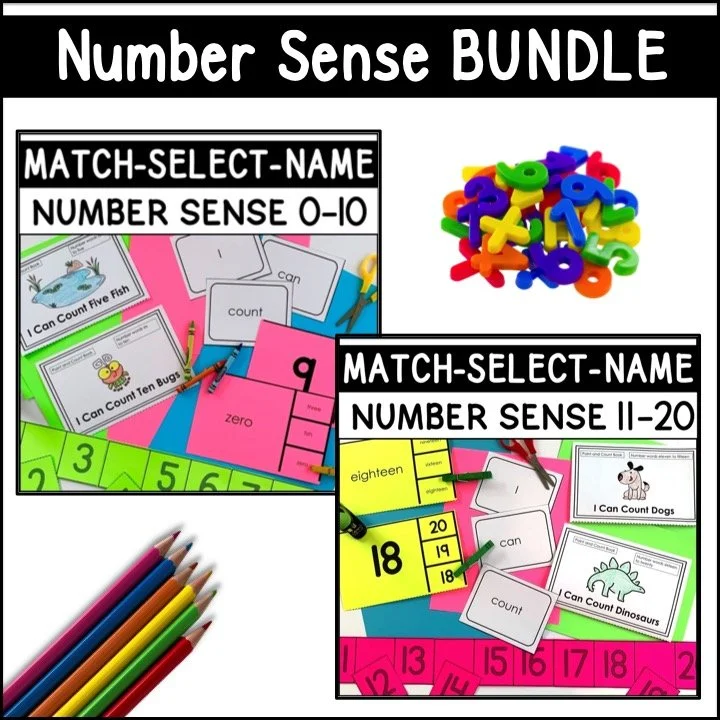
This is a comprehensive guide for teaching number sense to visual learners. It was specifically created to meet the needs of students with Down Syndrome, autism, learning disabilities, hearing loss and for students with intellectual disabilities. CLICK THE PHOTO ABOVE TO LEARN MORE
Note: Books that focus on numbers 11-20 are taught with the same step-by-step method as 0-10.
Looking for more free teaching resources?
If you also work with beginning readers, you can download my free Fry Sight Word Activity Packet with 20 ready-to-use activities.